Difference between generative ai vs traditional AI with examples

Introduction
Artificial Intelligence isn’t some idea for the future anymore—it’s here, and most of us use it without even noticing. You ask Siri a quick question, Alexa turns on the lights, Netflix suggests what to watch next… and that’s just the small stuff. In places like banks or hospitals, AI is even bigger—spotting fraud, predicting what patients might need, saving time that people usually don’t have. Pretty wild when you think about it.
But here’s the catch: not all AI works the same way. Over the years, two main types have really stood out. One is what’s often called Traditional AI, and the other—much newer and talked about a lot—is Generative AI.
Traditional AI (sometimes called narrow AI) is basically the rule-follower. It takes neat, organized data, looks for patterns, and then makes predictions. Simple, but powerful. That’s why your bank texts you about “suspicious activity” or why shopping sites show you “recommended for you” lists.
Generative AI is different. Instead of just analyzing, it makes things. Words and pictures and music and even code. Tools are like ChatGPT or DALL·E prove that machines can do more than just crunch numbers they can actually produce new content that feels, well, kind of human. Strange and right?
So which one’s better? Honestly… neither. They’re good at different things. Traditional AI is steady and reliable. Generative AI is creative and flexible. Together, they cover way more ground than either could alone. That’s really the point of this guide: to show how they work, where they’re used, and why both will matter in the future.
If you’re interested in building real-world skills, explore our Generative AI Training in Hyderabad designed for beginners and professionals looking to grow in AI careers.
What is Traditional AI?
Okay, so Traditional AI—sometimes called narrow AI or rule-based AI—is kinda the old-school version of AI. It doesn’t really make new stuff like generative AI does. Mostly, it just looks at organized data, spots patterns, and then tries to predict or sort things based on rules. Simple stuff, but it works… it really does.
Under the hood, it uses things like reversion models, decision trees, clustering, and support vector machines. Basically, it learns from examples. Like, if you feed it a bunch of customer purchases, it can guess what someone might buy next. Not perfect, I mean, it misses sometimes, but most of the time it’s okay.
Traditional AI is super focused. Give it a clear task, and it’ll handle it consistently. That’s why it’s everywhere spam detection, spam filtering, credit scoring, predicting trends, even helping doctors with diagnoses. But, honestly, when things get messy—like free-flowing text, images, or natural conversations—it kinda struggles. It just can’t deal with that very well.
And yeah, it’s everywhere. Banks, hospitals, shops, factories… you name it. People trust it because it follows rules, so you can actually see what it’s doing. When mistakes could cost a lot, that transparency matters. You kinda need that in the real world.
What is Generative AI?
What is Generative AI? : So, Generative AI… yeah, it’s basically the type of AI that makes new stuff. Not just predicting or analyzing like the old-school AI. Traditional AI sticks to rules and neat data, but generative AI? It can deal with messy things—text, images, audio, even videos. Pretty wild, right? It can make things that feel creative, almost like a human made them. People are using it everywhere now.
Under the hood, it’s kind of complicated. There are GANs—Generative Adversarial Networks. Basically, two neural networks competing are one makes stuff, the other tries to figure out if it’s real or fake. They push each other to get better. Then there are transformers, like what powers ChatGPT. They help the AI understand context and make text that actually makes sense. And oh, diffusion models too… another way to generate images and other things. Honestly, it’s a lot to wrap your head around.
You’ve probably seen it already—chatbots that answer your questions, image generators like DALL·E or MidJourney, AI-created music, even coding tools like GitHub Copilot. Businesses use it for content, marketing, designs, or just to get stuff done faster.
The crazy thing? It doesn’t just repeat what it’s seen. It learns patterns and comes up with new outputs. Kind of like bridging the gap between boring number-crunching and actual creativity. And, I mean… with everyone wanting more automation but also something fresh and new, generative AI is definitely going to shake up how we interact with technology.
Evolution from Traditional AI to Generative AI
Okay, so AI has come a long way… seriously, it’s kinda wild. We started with simple rule-based systems a long time ago—mid-20th century stuff. They called it symbolic AI back then. Basically, it was all rules, logic, and structured data. Could do things like play chess or make basic decisions. But if it ran into something outside the rules? Forget it.
Then machine learning came along and changed the game. Suddenly AI could actually learn from data. That meant it could predict things, spot patterns, get more accurate over time. People started using regression, decision trees, clustering… for real stuff in healthcare, finance, manufacturing. Pretty neat, right?
After that, deep learning and neural networks showed up. This was huge because now AI could handle messy stuff—images, text, audio… all sorts of unstructured data. And that’s when generative AI started to make sense. GANs, transformer-based language models—they could make original stuff. Human-like text, realistic images, music… it’s kinda crazy.
Now, generative AI is really at the cutting edge. Shows how far we’ve come from rule-following, deterministic systems to creative, adaptive tech that’s changing industries. Honestly, it’s pretty amazing what a few decades of research and experimentation can do.
Difference Between Generative AI vs Traditional AI
Alright, so the difference between Generative AI and Traditional AI… well, it’s kind of important if you’re into AI, or a business, or just curious. Both are part of AI, obviously, but they do very different things.
1.Purpose and Function
Traditional AI mostly assuming data, makes predictions, and helps automate decisions. It’s really good at stuff like classification, forecasting, or optimization. Generative AI? That’s the creative one. It can actually make new stuff—text, images, music, even code—and it tries to act kind of like a human.
2.Data Type
Traditional AI usually sticks to neat, structured data you know, numbers and labeled datasets. Generative AI is a bit sticky. It can handle unstructured stuff like text and audio and video and images. That’s why it’s more flexible when it comes to creative tasks.
3.Learning Approach
Traditional AI leans heavily on supervised learning and stats algorithms. Generative AI uses deep learning, unsupervised stuff, and transformer-based models. That’s how it can figure out patterns in really complicated data.
4.Output and Flexibility
Traditional AI gives specific outputs—predictions, recommendations, classifications. Generative AI can actually create new stuff, adapt to different situations, and sometimes surprise you. Entertainment, marketing, coding… it can do a lot of things.
5.Use Cases
You’ll see traditional AI in fraud detection, predictive analytics, medical diagnostics, and recommendation systems. Generative AI? Chatbots, AI-generated art, content creation, synthetic data… all kinds of stuff. Pretty wild, right?
Traditional AI vs Generative AI
| Feature | Traditional AI | Generative AI |
|---|---|---|
| Primary Function | Predict & analyze | Generate new content |
| Data Type | Structured | Unstructured & multimodal |
| Learning Method | Supervised/statistical | Deep learning/unsupervised |
| Output | Predictions & classifications | Original content |
| Flexibility | Narrow, task-specific | Broad & creative |
How Generative AI Works
So, generative AI… yeah, it basically learns patterns from huge amounts of data and then makes new stuff that’s kind of human-like. Unlike traditional AI, which just predicts outcomes based on rules, generative AI figures out how things are related and uses that to generate text, images, audio, even code. Pretty crazy if you think about it.
The core of it involves some fancy models like GANs, transformers, and diffusion models:
GANs: short for Generative Adversarial Networks. Basically, two neural networks are playing this little game. One tries to make content, the other checks if it’s real or fake. They push each other until the generator gets really good. People use this for AI art, synthetic images, and even deepfakes.
Transformers: these are what power stuff like ChatGPT. They’re awesome at handling sequences, like text. They get context, figure out relationships between words, and can generate coherent text or simulate a conversation that feels real.
Diffusion Models: these start with random noise and slowly turn it into a proper image. That’s how AI makes high quality images, which is super useful for design and creative stuff.
The Generative AI usually needs a ton of data and a lot of processing power. It learns by seeing patterns over and over, tweaking itself to make fewer mistakes. Once trained, you can give it prompts and it’ll make new stuff. Pretty versatile creative industries, coding, personalization… you name it.
So yeah, generative AI is basically changing how we interact with machines. It’s not just about automation anymore—it’s automation with a creative edge. I mean, it’s kinda wild when you really think about it.
How Traditional AI Works
Okay, so Traditional AI… yeah, it’s the kind that works with structured rules to solve certain problems. Not like generative AI, which actually makes new stuff. Traditional AI mostly looks at data, makes predictions, and automatic decisions based on patterns it’s seen. The workflow is usually are in three parts: collect the data, train the model, and then do projection or classifications.
Data Collection and Preprocessing: You need structured data—numbers, categories, labeled datasets. Before training, you have to clean it up, normalize it, organize it… basically make sure the AI doesn’t get confused.
Model Training: Then you use algorithms—linear regression, logistic regression, decision trees, SVMs, clustering… the AI learns how inputs relate to outputs. So it can make predictions or classifications that actually make sense.
Prediction and Decision Making: Once trained, it can analyze new data and give outputs. Like spotting fraud, predicting what a customer might do, or catching anomalies in manufacturing. And the results stick to the rules it learned. Deterministic, you know?
Traditional AI is everywhere—finance, healthcare, retail, manufacturing… you name it. People like it because it’s reliable, efficient, and the results are explainable. Super important when mistakes could be costly.
But it has limits. It’s not creative. It can’t really deal with messy, unstructured stuff. That’s the big difference from generative AI, which thrives at making new content and solving creative problems.
Benefits of Generative AI
So, Generative AI… yeah, it has a lot of advantages that go beyond what traditional AI can do. One big thing is content creation. I mean, it can make text, images, music, videos, even code. That kind of stuff normally takes forever, but generative AI speeds it up a lot. Super handy for marketing, entertainment, design… basically anywhere you need to be fast and creative.
Another cool thing is personalization. Generative AI can tweak content and experiences for individual users. So businesses can make custom marketing campaigns, personalized learning material, or chatbots that actually feel adaptive. That usually keeps people more engaged and happier, and it saves time too.
It also helps boost productivity. Like, it can take over repetitive tasks that still need a bit of creativity—drafting reports, designing graphics, generating code templates… you get the idea. That way the humans can be focus on bigger decisions and strategy.
And on top of that, it’s great for quick prototyping and testing new ideas. You can simulate scenarios, explore creative solutions, and do it with minimal risk. Basically, generative AI is becoming a tool you really can’t ignore if you want to combine efficiency with creativity.
Benefits of Traditional AI
So, Traditional AI… yeah, it’s got a bunch of advantages, especially if you’re working with structured data, predictions, and automation. One big thing? Accuracy and reliability. I mean, models like decision trees, regression, SVMs—they’re really good at analyzing huge datasets and giving precise predictions. Super important in finance, healthcare, manufacturing… you know, the usual.
Another thing is efficiency. Traditional AI can handle repetitive stuff—transaction monitoring, quality control, customer segmentation—with hardly any human help. Saves time, cuts costs, boosts productivity… not bad, right?
It’s also pretty interpretable. You can usually see how the decisions are made and which is huge in regulated industries like banking or healthcare. Compliance and accountability matter a lot there.
Plus, it has a proven track record for domain-specific problems. Recommendation systems, predictive maintenance, fraud detection, supply chain optimization… all of that, and it actually works.
Sure, it’s not creative like generative AI, but that doesn’t matter for everything. Traditional AI is still a powerhouse for structured problem solving and data driven decisions and streamlining processes. I guess that’s why people keep using it.
Limitations of Generative AI
So, generative AI… yeah, it’s super powerful, but it’s not without problems. First off, there’s the whole misinformation and bias thing. I mean, these models learn from huge datasets that aren’t perfect. So sometimes they just spit out stuff that’s misleading, biased, or even inappropriate.
Then there’s the computational side. Training these models—large language models, GANs, all that—needs a ton of computing power, storage, and massive datasets. Expensive, time-consuming… not exactly easy for smaller teams.
Ethics is another headache. Who owns AI-generated art, music or writing or Copyright and creative rights get messy fast.
Also, these models are kinda like black boxes. You don’t really see how they make decisions. Makes it hard to fully trust them, especially in serious areas like healthcare, finance, or legal stuff.
And yeah… there’s the misuse factor. Deepfakes and phishing and synthetic media spreading misinformation… people can do some shade things. So even though generative AI is transformative, you really need to be careful, follow rules, and have ethical safeguards.
Limitations of Traditional AI
So, traditional AI… yeah, it works really well for structured tasks, but it’s got some limits. First off, it’s not exactly creative or adaptable. I mean, it’s designed for specific rule-based stuff, so it can’t really make new content or handle surprises outside its training data.
Another thing is that it really depends on clean, organized, labeled data. Getting all that ready takes time and can be pricey. And if the data isn’t perfect, well… the predictions might not be reliable.
Traditional AI is also pretty task-specific. A model trained for one thing, like fraud detection, can’t just switch over to a creative task without a ton of retraining. So, not super scalable across different applications.
It also struggles with unstructured data—images, text, audio… the stuff that’s becoming more important these days.
And yeah, it usually needs a lot of human oversight during development and testing and deployment to make sure it’s accurate and compliant.
Still, despite all this, traditional AI is kind of a cornerstone for industries that need precise, data driven decisions.
Real-World Applications of Generative AI
Generative AI… yeah, it’s really shaking things up in a bunch of industries. Marketing and advertising is a big one. Companies use it to make personalized content—ad copy, social media posts, emails, product descriptions… all that. Speeds things up and helps target customers better, you know?
In entertainment, it’s kinda crazy. AI can make realistic images, videos, even music. Artists, designers, filmmakers… they can use it to bring ideas to life. Tools like DALL·E and MidJourney help designers quickly mock up visual concepts, and AI music generators let composers mess around with new sounds and melodies.
Healthcare is getting in on it too. Generative AI can help with drug discovery, make synthetic medical images for research, simulate complex biological processes… basically speeding up innovation while cutting costs and risk.
Education? agreed, it’s there. AI powers personalized learning platforms, making tailored study materials, summaries, and even tutoring interactions that fit each student’s needs.
Software development also benefits. Tools like GitHub Copilot can spit out code snippets, help debug stuff, and speed up programming.
So yeah… generative AI isn’t just about creativity. It also helps with efficiency, productivity, and personalization across a ton of industries. I guess that’s why it’s becoming such a big deal.
Real-World Applications of Traditional AI
Traditional AI… yeah, it’s still super useful in a bunch of industries. Take finance. It’s used for fraud detection, credit scoring, risk assessment, even algorithmic trading. These models handle huge amounts of structured data, spot weird stuff, find patterns, and help people make decisions. Pretty accurate too.
Healthcare uses it a lot as well. Helps with diagnostics, looking at medical images, patient monitoring, predictive modeling… stuff like that. For example, it can catch early signs of cancer or heart problems by analyzing structured patient data. That way, doctors can step in sooner.
Manufacturing? Yep. Predictive maintenance, quality control, supply chain optimization… AI watches equipment, checks production data, predicts when things might break, reduces downtime, keeps things running smoother.
Retail also benefits. Demand forecasting, inventory management, recommendation engines… e-commerce sites look at what people buy, what they like, suggest products, optimize stock… you get the idea.
Transportation and logistics? Sure. Route process improvement and fleet management and traffic prediction… AI crunches the operational data and makes things more efficient, saves money.
So yeah, The overall, traditional AI is still key for stuff that needs accuracy, efficiency, and predictability—especially when you’re working with structured data and rule-based decision-making.
Use Cases Comparison: Generative AI vs Traditional AI
So, comparing Generative AI and Traditional AI… yeah, it kinda depends on the industry and what you need. In healthcare, for example, traditional AI is mostly about disease prediction, patient monitoring, and diagnostic analysis. Generative AI, though, goes a bit further. It can make synthetic medical images, simulate biological processes, and even help with drug discovery. That lets researchers move faster and cut costs, which is pretty cool.
Finance is similar. Traditional AI handles fraud detection, credit scoring, and risk analysis by looking at historical data. Generative AI adds some creative stuff—automating report writing, generating financial simulations, and producing predictive narratives. Analysts can use that to make better-informed decisions.
Marketing and retail? Traditional AI does the usual—segmenting customers, predicting what they’ll buy, managing inventory. Generative AI jazzes it up by making personalized ads, automated social media posts, and creative campaigns. Helps with engagement and brand loyalty, you know?
And in education, traditional AI helps predict student performance and grade stuff. Generative AI goes a step further—personalized learning experiences, interactive tutoring, creating content that fits individual needs. Makes learning way more tailored.
Traditional AI vs Generative AI Use Cases by Industry
| Industry | Traditional AI Use Cases | Generative AI Use Cases |
|---|---|---|
| Healthcare | Disease prediction, patient monitoring | Drug discovery, synthetic medical images |
| Finance | Fraud detection, risk analysis | Automated reports, financial simulations |
| Marketing/Retail | Customer segmentation, inventory optimization | Personalized content, creative campaigns |
| Education | Predictive analytics, grading | Personalized learning, tutoring tools |
By analyzing these use cases, it becomes clear that traditional AI excels in structured prediction, while generative AI thrives in creative and adaptive tasks, making them complementary technologies.
Ethical Considerations
So, AI is getting smarter all the time, and ethics… yeah, that’s becoming a huge deal. One big thing is bias and fairness. I mean, generative or traditional, the AI learns from historical data, right? And sometimes that data is kind of biased. If you’re not careful, the AI can make unfair decisions or just reinforce the same inequalities that were already there.
Generative AI brings extra headaches. It can make realistic text, images, audio, videos… which is awesome, but also risky. Misinformation, deepfakes, content manipulation… people could use it to spread false stories or even impersonate someone. Copyright issues too. So, keeping the AI ethical and transparent and supportable… yeah, that’s on developers and companies.
The Traditional AI isn’t perfect either, especially in high stakes stuff like healthcare, finance, or criminal justice. You need transparency and accountability. Mistakes or bias can seriously hurt people. The difference is, traditional AI decisions are usually easier to explain… but you still gotta monitor it.
Regulations are starting to pop up—like the EU AI Act and ethics guidelines from boards. Companies need to do responsible AI things: check for bias, be transparent, protect privacy, keep humans involved.
At the end of the day… it’s not just about following rules. It’s about building trust and credibility. People need to actually rely on AI without it causing harm, you know?
Future of AI: Convergence of Generative and Traditional AI
So, thinking about the future of AI… it’s probably in mixing generative and traditional AI. I mean, the traditional AI is really good at structured and data driven stuff, but generative AI brings creativity and the ability to make new things. Put them together, and you get something way more powerful and flexible.
In the healthcare, for example, you could combine predictive models with generative AI. That way, you can design new drugs, simulate patient outcomes, and even personalize treatments. In finance, traditional AI can spot fraud and assess risk, and generative AI can write reports, simulate market scenarios, and help with decisions.
Creative industries get a boost too. AI can look at trends, figure out what people like, and then actually make original content based on that. Same in education—AI can mix analytics with generative tools to make learning materials that adapt to each student.
This hybrid idea also works for autonomous systems, smart cities, and human-AI collaboration. Basically, it’s about balancing structured problem-solving with creative decisions.
As computers get faster and AI keeps improving, this mix of generative and traditional AI is probably what’s going to drive the next wave of tech innovation. Could really change industries and society… in some pretty big ways, you know?
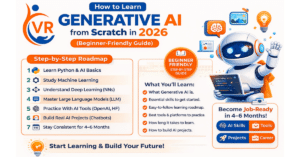
Beginners can follow this structured Generative AI roadmap to understand the skills, tools, and technologies required to build a career in AI.
Conclusion
When you think about Generative AI vs Traditional AI… yeah, they both have their own strengths. Traditional AI is really good at structured, data-driven stuff—accurate, reliable, easy to interpret. That’s why finance, healthcare, and manufacturing use it a lot. Generative AI, on the other hand, is more about creativity and making new content. Marketing, entertainment, education, software… it really shines there.
But here’s the thing—you don’t have to choose one over the other. If you mix them, you get something pretty powerful. The Traditional AI can handle the data analysis, and generative AI can make human-like outputs. Together, it can be more efficient and personalized and even innovative.
Of course, you can’t just let it run wild. Ethics matter. Bias, transparency, copyright, content verification… all that has to be considered. Following regulations and keeping humans in the loop is key to trust and safety.
Looking ahead, combining generative and traditional AI is probably what’s going to reshape industries. It can boost productivity, creativity, and innovation. Understanding how each works and how they can work together helps organizations use AI smartly and ethically… for growth that actually lasts.
If you want hands-on experience, enroll in our Agentic AI course in Hyderabad and build real-world AI solutions.
Read Also