
Introduction to Generative AI Syllabus
The generative ai syllabus is designed to help learners understand, build, and deploy modern AI systems that can generate human-like text, images, code, audio, and more. In today’s fast-changing technology world, Generative AI has become one of the most in-demand skills across IT, software development, data science, digital marketing, and automation roles.
Unlike traditional AI courses that focus mainly on theory, a job-oriented generative ai syllabus emphasizes practical learning. It covers everything from AI fundamentals and Python basics to advanced topics like Large Language Models (LLMs), prompt engineering, AI agents, vector databases, and real-world GenAI projects. This structured approach ensures learners don’t just “learn concepts” but also apply them in real-time scenarios. This comprehensive syllabus is part of our industry-ready Generative AI Course in Hyderabad, designed to make learners job-ready.
With tools like ChatGPT, Gemini, LangChain, Hugging Face, Stable Diffusion, and OpenAI APIs being adopted rapidly by companies, organizations are actively looking for professionals who understand the complete Generative AI workflow. That is why having a clear and updated generative ai syllabus is critical for anyone planning a future-proof career.
This syllabus is especially useful for:
-
Students and fresh graduates entering the tech industry
-
Software developers upgrading their skills
-
Data analysts moving into AI roles
-
Professionals aiming for high-paying AI jobs
At VR Generative AI, the generative ai syllabus is curated based on:
-
Current industry hiring needs
-
Real-world project requirements
-
Startup and product-company expectations
-
Global AI trends for 2025–2026
In this article, you will get a complete breakdown of the generative ai syllabus, starting from beginner concepts and moving step-by-step toward advanced GenAI applications. Each section is designed to be easy to understand, SEO-friendly, and aligned with Google’s EEAT guidelines, making this content useful for both learners and search engines.
By the end of this guide, you will clearly understand what to learn, why to learn, and how to build a career using Generative AI.
What is Generative AI? (Basics Explained)
Generative AI is a branch of artificial intelligence that focuses on creating new content instead of just analyzing existing data. Simply put, Generative AI systems can generate human-like text, realistic images, videos, audio, and even computer code based on the input given by users.
In a modern generative ai syllabus, this concept is explained from the ground up so that beginners can clearly understand how machines “create” content that looks intelligent and natural.
How Generative AI Works (Simple Explanation)
Generative AI models are trained on large volumes of data such as text, images, and code. Using deep learning techniques—especially neural networks and transformer models—they learn patterns, context, and relationships within the data. Once trained, these models can:
-
Predict the next word in a sentence
-
Create new images from text descriptions
-
Generate code snippets
-
Answer questions like a human
Common Types of Generative AI
A well-structured generative ai syllabus covers multiple types of Generative AI, including:
-
Text Generation
Examples: ChatGPT, Gemini, Claude -
Image Generation
Examples: DALL·E, Midjourney, Stable Diffusion -
Code Generation
Examples: GitHub Copilot, Code LLMs -
Audio & Video Generation
Examples: AI voice tools, video generators
Generative AI vs Traditional AI (Quick Comparison)
| Feature | Traditional AI | Generative AI |
|---|---|---|
| Purpose | Predict / Classify | Create new content |
| Output | Yes / No, Numbers | Text, Images, Code |
| Creativity | Limited | High |
| Examples | Spam filters | ChatGPT, DALL·E |
Why Generative AI is Important
Generative AI is transforming how businesses operate. From customer support chatbots and marketing content to AI-powered search engines and automation tools, companies are rapidly adopting GenAI solutions. That’s why learning the fundamentals through a complete generative ai syllabus is critical for future-ready careers.
This section builds the foundation for understanding advanced topics like Large Language Models (LLMs), prompt engineering, and AI agents, which are covered later in this syllabus.

Why Learn Generative AI in 2025–2026?
Learning Generative AI in 2025–2026 is no longer optional—it has become a career-defining skill. Companies across the globe are rapidly adopting Generative AI to automate tasks, improve productivity, reduce costs, and create intelligent products. This is the main reason why a well-structured generative ai syllabus is gaining massive importance among students and working professionals.
Massive Industry Demand
Generative AI is being used in almost every domain:
-
Software development (AI copilots, code generation)
-
Customer support (AI chatbots)
-
Digital marketing (content & ad copy generation)
-
Healthcare (medical reports & analysis)
-
Finance (risk analysis & automation)
-
Education (AI tutors & learning tools)
Because of this wide adoption, companies are actively hiring professionals who understand the complete generative ai workflow, not just basic AI theory.
High-Paying Job Opportunities
One of the biggest reasons to follow an updated generative ai syllabus is salary growth.
Average Salary in India (Approx):
-
Freshers: ₹6 – ₹10 LPA
-
2–4 years experience: ₹12 – ₹20 LPA
-
Experienced GenAI Engineers: ₹25 LPA+
Globally, Generative AI professionals are among the top-paid tech roles.
Future-Proof Career
Traditional roles are slowly getting automated, but Generative AI is creating new job roles, such as:
-
Generative AI Engineer
-
Prompt Engineer
-
LLM Engineer
-
AI Product Developer
By learning from a future-ready generative ai syllabus, you stay ahead of automation instead of being replaced by it.
Strong Advantage Over Other Skills
Compared to traditional courses, Generative AI offers:
-
Faster career growth
-
Higher salary potential
-
Global job opportunities
-
Startup + product-company demand
That’s why 2025–2026 is the best time to invest in learning Generative AI using a structured, industry-aligned syllabus.
Generative AI Syllabus – Beginner Level

The beginner level of the generative ai syllabus is designed for learners who are new to Artificial Intelligence or Generative AI. This stage focuses on building strong fundamentals, so that learners can confidently move to advanced GenAI concepts like LLMs, prompt engineering, and AI agents.
This level does not assume prior AI knowledge. Even students from non-technical backgrounds can easily follow this structured learning path.
Module 1: Introduction to Artificial Intelligence
This module helps learners understand the core ideas behind AI.
Topics Covered:
-
What is Artificial Intelligence?
-
History and evolution of AI
-
-
Narrow AI
-
General AI
-
Super AI
-
-
Real-world examples of AI
-
Difference between AI, Machine Learning, and Deep Learning
Outcome:
Learners gain clarity on how Generative AI fits into the broader AI ecosystem.
Module 2: Python Programming Fundamentals
Python is the backbone of modern AI development. Any industry-ready generative ai syllabus must include Python basics.
Topics Covered:
-
Introduction to Python
-
Variables and data types
-
Conditional statements
-
Loops
-
Functions
-
Basic object-oriented concepts
-
Writing clean and readable code
Why this matters:
Python is widely used in Generative AI frameworks like LangChain, Hugging Face, and OpenAI APIs.
Module 3: Python Libraries for AI
This module introduces essential Python libraries required for AI and data handling.
Libraries Included:
-
NumPy – numerical operations
-
Pandas – data handling and analysis
-
Matplotlib & Seaborn – data visualization
Skills You Learn:
-
Handling datasets
-
Cleaning data
-
Understanding patterns using graphs
-
Preparing data for AI models
Outcome:
You’ll be comfortable working with real-world data before moving to Generative AI models.
Module 4: Fundamentals of Generative AI
This is where the generative ai syllabus truly begins.
Topics Covered:
-
How generative models work
-
Introduction to neural networks
-
Basics of deep learning
-
Concept of training data
-
Understanding tokens and embeddings (basic level)
Examples Explained:
-
Text generation
-
Image generation
-
Code generation
Outcome:
Clear understanding of how machines “generate” content instead of just predicting outcomes.
Module 5: Basics of Natural Language Processing (NLP)
Since most Generative AI applications deal with text, NLP is a core part of the beginner syllabus.
Topics Covered:
-
What is NLP?
-
Text preprocessing
-
Tokenization
-
Stop words
-
Stemming & lemmatization
-
Bag of Words (BoW)
-
TF-IDF (intro level)
Why this is important:
NLP concepts form the foundation for Large Language Models (LLMs) covered in later stages of the generative ai syllabus.
Module 6: Introduction to Large Language Models (LLMs)
This module gives a beginner-friendly introduction to LLMs.
Topics Covered:
-
What are Large Language Models?
-
How models like ChatGPT work (high level)
-
Transformers – simple explanation
-
Training vs inference
-
Limitations of LLMs
Outcome:
Learners understand what happens behind tools like ChatGPT before using them practically.
Beginner-Level Learning Outcomes (Summary)
By the end of this beginner stage in the generative ai syllabus, learners will be able to:
-
Understand AI & Generative AI fundamentals
-
Write basic Python programs
-
Work with data using Python libraries
-
Understand NLP basics
-
Clearly explain how Generative AI works
This strong foundation ensures a smooth transition into Intermediate-level Generative AI topics like prompt engineering, APIs, and real-time applications.
Generative AI Syllabus – Intermediate Level

The intermediate level of the generative ai syllabus is where learners move from theory to real-world implementation. At this stage, you already understand AI basics, Python, and NLP fundamentals. Now, the focus shifts toward working with Large Language Models (LLMs), prompt engineering, APIs, and building practical Generative AI applications.
This level is critical because most companies expect candidates to have hands-on GenAI skills, not just conceptual knowledge.
Module 1: Deep Dive into Large Language Models (LLMs)
Large Language Models are the backbone of Generative AI applications. Any industry-ready generative ai syllabus must cover LLMs in detail.
Topics Covered:
-
What are Large Language Models?
-
How LLMs are trained (high-level overview)
-
Transformer architecture (simplified explanation)
-
Popular LLMs: GPT, Gemini, LLaMA
-
Tokens, context window, and temperature
-
Strengths and limitations of LLMs
Outcome:
Learners understand how models like ChatGPT generate meaningful responses.
Module 2: Prompt Engineering (Core Skill)
Prompt engineering is one of the most in-demand skills in the Generative AI job market.
Topics Covered:
-
Types of prompts
-
Zero-shot prompts
-
Few-shot prompts
-
Chain-of-thought prompts
-
-
System, user, and assistant prompts
-
Prompt optimization techniques
-
Avoiding hallucinations
Real-Time Practice Includes:
-
Writing effective prompts for content generation
-
Designing prompts for data analysis
-
Creating prompts for chatbot responses
Outcome:
Ability to control and optimize AI outputs using well-crafted prompts.
Module 3: Working with Generative AI APIs
This module focuses on connecting AI models with real applications.
APIs Covered:
-
OpenAI API
-
Google Gemini API
-
Hugging Face Inference API
Topics Covered:
-
API authentication
-
Sending prompts using Python
-
Handling responses
-
Error handling & rate limits
-
Cost optimization basics
Hands-on Task:
Build a simple AI-powered chatbot using APIs.
Module 4: Building Generative AI Applications
This module teaches how to turn AI models into usable products.
Topics Covered:
-
AI application architecture
-
Integrating LLMs with Python
-
Creating user interfaces using Streamlit
-
Connecting frontend with AI backend
-
Deploying basic GenAI apps
Outcome:
Learners can build and deploy their own Generative AI applications.
Module 5: Introduction to Embeddings & Semantic Search
Embeddings play a key role in advanced Generative AI workflows.
Topics Covered:
-
What are embeddings?
-
How text embeddings work
-
Semantic similarity search
-
Use cases of embeddings
-
Intro to vector databases (concept level)
Outcome:
Foundation for advanced topics like RAG (covered in the advanced generative ai syllabus).
Intermediate-Level Learning Outcomes (Summary)
After completing the intermediate stage of the generative ai syllabus, learners will be able to:
-
Understand LLM internals at a practical level
-
Write effective prompts for multiple use cases
-
Use Generative AI APIs with Python
-
Build and deploy basic AI applications
-
Prepare for advanced GenAI frameworks
This stage acts as a bridge between fundamentals and advanced, industry-grade Generative AI systems.
Generative AI Syllabus – Advanced Level
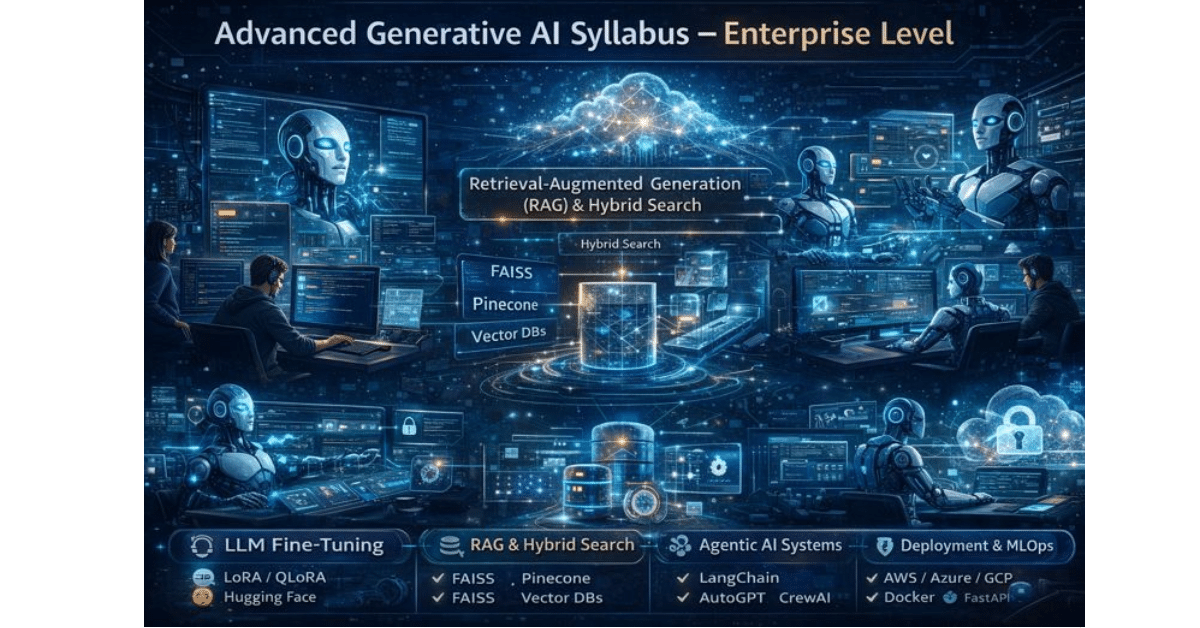
Overview: Advanced Generative AI Syllabus
The advanced level of the generative ai syllabus is designed for learners who want to build enterprise-grade, production-ready Generative AI systems. This stage focuses on advanced architectures, real-world scalability, autonomous AI systems, and responsible AI practices.
By this level, learners already understand AI fundamentals, Python, NLP, LLMs, and prompt engineering. The advanced syllabus helps you move from using Generative AI tools to designing, optimizing, and deploying complete GenAI solutions used by real companies.
This is the level that prepares you for senior AI roles, product-based companies, startups, and global opportunities.
Module 1: Fine-Tuning Large Language Models (LLMs)
Fine-tuning is a critical part of any advanced generative ai syllabus, especially for building domain-specific AI systems.
Topics Covered:
-
Pre-trained models vs fine-tuned models
-
Instruction fine-tuning
-
Supervised Fine-Tuning (SFT)
-
Parameter-Efficient Fine-Tuning (PEFT)
-
LoRA and QLoRA techniques
-
Dataset preparation and validation
-
Token optimization strategies
Practical Outcome:
Build customized LLMs for specific business use cases such as HR chatbots, customer support bots, or internal knowledge assistants.
Module 2: Retrieval-Augmented Generation (RAG) – Advanced Concepts
RAG is one of the most in-demand skills in modern Generative AI development and a must-have component of an advanced generative ai syllabus.
Topics Covered:
-
Deep understanding of vector embeddings
-
Vector database architecture
-
Chunking strategies (fixed, semantic, recursive)
-
Hybrid search (vector + keyword search)
-
Query rewriting and response reranking
-
Improving accuracy and reducing hallucinations
Popular Tools Covered:
-
FAISS
-
Pinecone
-
Weaviate
-
ChromaDB
Practical Outcome:
Build AI systems that answer questions accurately using private or enterprise data.
Module 3: Agentic AI Systems (Autonomous AI Agents)
Agentic AI is one of the fastest-growing areas in Generative AI for 2025–2026.
What You Will Learn:
-
How autonomous agents plan and execute tasks
-
Tool calling and function execution
-
Memory and decision-making in agents
-
Multi-agent collaboration systems
Frameworks Covered:
-
LangChain Agents
-
AutoGPT
-
CrewAI
-
OpenAI Assistants API
Real-World Example:
An AI agent that reads emails, analyzes data, schedules tasks, and generates reports automatically.
Learners interested in autonomous systems can explore our specialized Agentic AI Course in Hyderabad for deeper practical exposure.
Module 4: Multimodal Generative AI
Advanced Generative AI is not limited to text. A strong generative ai syllabus must include multimodal AI capabilities.
Modalities Covered:
-
Text-to-Image generation
-
Text-to-Video generation
-
Text-to-Audio generation
-
Image-to-Text understanding
-
Speech-to-Text and Text-to-Speech systems
Models & Tools Covered:
-
GPT-4 Vision
-
DALL·E
-
Stable Diffusion
-
Whisper
-
Text-to-Speech APIs
Practical Outcome:
Build AI applications that work with text, images, audio, and video together.
Module 5: Model Deployment & MLOps for Generative AI
This module focuses on taking Generative AI models from development to production.
Topics Covered:
-
Building APIs using FastAPI
-
Docker and containerization
-
Cloud deployment (AWS, Azure, GCP – overview)
-
Scaling AI applications
-
Monitoring, logging, and performance tracking
-
Cost optimization strategies for GenAI applications
Practical Outcome:
Deploy scalable, secure, and cost-efficient Generative AI applications.
Module 6: Security, Ethics & Responsible AI
Trust and safety are critical for real-world AI systems and are an essential part of an advanced generative ai syllabus.
Topics Covered:
-
Data privacy and compliance
-
Prompt injection attacks
-
Model hallucinations and mitigation
-
Bias detection and fairness
-
Responsible AI principles
-
AI governance best practices
Outcome:
Build secure, ethical, and trustworthy AI solutions that comply with industry standards.
Advanced-Level Real-Time Projects
| Project Name | Skills Applied |
|---|---|
| Enterprise RAG Chatbot | LLMs, Vector Databases |
| Autonomous AI Agent | Agentic AI, Tool Calling |
| Multimodal AI Application | Vision + NLP |
| AI Coding Assistant | Prompt Engineering |
| Production AI API | Deployment & Security |
Advanced-Level Learning Outcomes
After completing this advanced generative ai syllabus, learners will be able to:
-
Design and build enterprise-grade GenAI systems
-
Fine-tune and optimize Large Language Models
-
Implement advanced RAG pipelines
-
Build autonomous AI agents
-
Deploy scalable and secure AI applications
This advanced stage makes learners industry-ready and future-proof.
Tools & Technologies Covered in Generative AI Syllabus

Overview: Tools Covered in Generative AI Syllabus
A high-quality generative ai syllabus is incomplete without hands-on experience using industry-standard tools and technologies. Companies do not hire candidates based on theory alone—they expect practical exposure to real tools used in production environments.
This section outlines all the tools, frameworks, platforms, and technologies covered as part of a complete, job-oriented Generative AI syllabus.
Generative AI Tools & Technologies (Comprehensive Table)
| Category | Tool / Technology | Purpose & Usage |
|---|---|---|
| Programming Language | Python | Core language for AI and GenAI development |
| AI Models | GPT, Gemini, LLaMA | Large Language Models for text generation |
| Prompt Engineering | ChatGPT, Gemini | Designing optimized prompts |
| AI APIs | OpenAI API, Gemini API | Connecting AI models to applications |
| Frameworks | LangChain | Building GenAI workflows and agents |
| Agent Frameworks | AutoGPT, CrewAI | Autonomous AI agents |
| Embeddings | OpenAI Embeddings | Semantic search and similarity |
| Vector Databases | FAISS | Local vector storage |
| Vector Databases | Pinecone | Cloud-based vector database |
| Vector Databases | ChromaDB | Lightweight vector database |
| NLP Libraries | NLTK, SpaCy | Text preprocessing |
| Model Hub | Hugging Face | Pre-trained models and datasets |
| Image Generation | DALL·E | Text-to-image generation |
| Image Generation | Stable Diffusion | Advanced image generation |
| Speech AI | Whisper | Speech-to-text |
| Frontend | Streamlit | AI app interfaces |
| Backend APIs | FastAPI | Production API development |
| Deployment | Docker | Containerized deployment |
| Cloud Platforms | AWS / Azure / GCP | Scalable AI deployment |
| Version Control | Git & GitHub | Code management |
| Monitoring | Logging tools | Model monitoring & debugging |
Why These Tools Matter in Real Jobs
This generative ai syllabus focuses on tools that are:
-
✅ Actively used by startups and enterprises
-
✅ Required in real job descriptions
-
✅ Suitable for scalable AI applications
-
✅ Aligned with global AI development standards
Learning these tools ensures learners are job-ready, not just certified.
Practical Exposure Approach
Learners will:
-
Build projects using multiple tools together
-
Integrate LLMs with APIs and databases
-
Deploy AI applications to cloud platforms
-
Work on real-world GenAI workflows
This tool-based learning approach makes the generative ai syllabus highly practical and industry-aligned.
Real-Time Projects & Use Cases in Generative AI Syllabus

Overview: Real-Time Learning in Generative AI Syllabus
A strong generative ai syllabus must focus on real-time projects and practical use cases, because companies hire candidates who can build, deploy, and explain real Generative AI solutions, not just understand theory.
This syllabus focuses heavily on Generative AI Training with Real-Time Projects, ensuring learners gain practical industry experience.
This section ensures learners gain hands-on experience by working on industry-relevant projects that closely match real job requirements in startups, enterprises, and product-based companies.
Why Real-Time Projects Matter
Real-time projects help learners to:
-
Apply Generative AI concepts in practical scenarios
-
Understand end-to-end AI workflows
-
Build confidence for interviews and jobs
-
Create a strong project portfolio
-
Demonstrate real skills to employers
That is why project-based learning is a core part of this generative ai syllabus.
Major Real-Time Projects Covered
AI-Powered Chatbot (LLM-Based)
Description:
Build a conversational chatbot using Large Language Models and APIs.
Skills Used:
-
Prompt engineering
-
LLM APIs (OpenAI / Gemini)
-
Python integration
Use Case:
Customer support, website assistants, internal helpdesk bots.
Retrieval-Augmented Generation (RAG) Application
Description:
Create an AI system that answers questions using private documents or company data.
Skills Used:
-
Embeddings
-
Vector databases
-
LangChain
-
Semantic search
Use Case:
Enterprise knowledge base, document search, policy assistants.
Autonomous AI Agent Project
Description:
Build an AI agent that can plan tasks, use tools, and execute workflows automatically.
Skills Used:
-
Agentic AI frameworks
-
Tool calling
-
Memory and reasoning
Use Case:
Task automation, report generation, workflow management.
Multimodal Generative AI Application
Description:
Develop an AI app that works with text, images, or audio together.
Skills Used:
-
Text-to-image generation
-
Image-to-text understanding
-
Speech-to-text
Use Case:
Content creation tools, media platforms, AI assistants.
Generative AI API Deployment Project
Description:
Deploy a complete Generative AI application as a production-ready API.
Skills Used:
-
FastAPI
-
Docker
-
Cloud deployment
-
Security & monitoring
Use Case:
Startup products, SaaS platforms, enterprise AI services.
Industry Use Cases Covered
This generative ai syllabus maps projects to real-world applications such as:
-
AI chatbots for websites
-
Resume screening systems
-
AI content generation tools
-
Internal company AI assistants
-
Automation tools for businesses
Learning Outcomes from Real-Time Projects
After completing these projects, learners will be able to:
-
Build real Generative AI applications from scratch
-
Explain project architecture clearly
-
Solve real business problems using AI
-
Showcase projects confidently in interviews
Career Opportunities After Learning Generative AI

Overview: Career Scope After Generative AI Syllabus
Completing a job-oriented generative ai syllabus opens doors to some of the fastest-growing and highest-paying careers in the tech industry. As companies rapidly adopt Generative AI across products, services, and automation, the demand for skilled professionals continues to rise globally.
This section explains the career roles, industries, and growth opportunities available after mastering Generative AI.
Top Job Roles After Learning Generative AI
After completing the generative ai syllabus, learners can apply for the following roles:
Generative AI Engineer
-
Build and deploy GenAI applications
-
Work with LLMs, APIs, and frameworks
-
Design end-to-end AI solutions
Skills Required:
LLMs, prompt engineering, Python, APIs, deployment
Prompt Engineer
-
Design optimized prompts for accurate AI outputs
-
Improve model performance and reduce hallucinations
-
Work closely with AI products and teams
Skills Required:
Prompt design, reasoning patterns, model behavior understanding
AI / LLM Engineer
-
Customize and fine-tune Large Language Models
-
Build RAG pipelines and embeddings
-
Optimize AI systems for performance
Skills Required:
LLMs, fine-tuning, vector databases, LangChain
AI Application Developer
-
Develop AI-powered web and SaaS applications
-
Integrate GenAI with frontend and backend systems
Skills Required:
Python, FastAPI, Streamlit, cloud deployment
Data Scientist / AI Specialist
-
Apply Generative AI for analytics and automation
-
Build intelligent data-driven solutions
Skills Required:
Python, data analysis, AI modeling, GenAI tools
Industries Hiring Generative AI Professionals
The generative ai syllabus prepares learners for multiple industries, including:
-
IT & Software Development
-
Startups & SaaS companies
-
Digital Marketing & Media
-
Healthcare & Life Sciences
-
Finance & Banking
-
E-commerce & Retail
-
Education & EdTech
Salary Expectations (India & Global)
Experience Level Average Salary (India) Fresher ₹6 – ₹10 LPA 2–4 Years ₹12 – ₹20 LPA Senior Roles ₹25 LPA+ Globally, Generative AI professionals earn significantly higher packages, especially in product-based companies and AI startups.
read More : Artificial Intelligence Salary in India for Freshers 2025
Career Growth & Future Outlook
Generative AI is not a temporary trend—it is reshaping how software is built and used. Learning from a structured generative ai syllabus ensures:
-
- Long-term career stability
- Global job opportunities
- Faster career growth
- Strong demand across industries

Who Should Learn This Generative AI Syllabus?
The generative ai syllabus is designed to suit a wide range of learners, from beginners to experienced professionals. As Generative AI is becoming a core skill across industries, this syllabus is structured to match different learning goals and career stages.
1. Students & Fresh Graduates
This syllabus is ideal for:
-
Engineering, computer science, and IT students
-
Final-year students planning AI-focused careers
-
Fresh graduates looking for high-paying tech roles
Students can build a strong foundation in AI concepts, LLMs, and real-world tools, making them job-ready early in their careers.
2. Working Professionals
Professionals from various domains can benefit, including:
-
Software developers (frontend, backend, full stack)
-
Data analysts and data scientists
-
QA engineers and automation testers
-
IT professionals planning a career transition to AI
The syllabus helps professionals upgrade their skills and move into future-proof AI roles.
3. Non-Technical Background Learners
Even if you are from a non-coding background, this generative ai syllabus is suitable because:
-
Concepts are explained in simple English
-
Tools are taught with practical examples
-
Low-code and no-code AI tools are included
Roles in AI product management, prompt engineering, and AI consulting become accessible.
4. Entrepreneurs & Startup Founders
Founders and business owners can use this syllabus to:
-
Build AI-powered products
-
Automate business processes using Generative AI
-
Understand AI feasibility before investing in solutions
5. Career Switchers
Anyone planning a shift from traditional roles to AI-driven careers can confidently follow this syllabus as it provides a structured learning path from basics to advanced implementation.
Generative AI Course Duration & Learning Path
Course Duration Overview
A well-structured generative ai syllabus is designed to balance theory, hands-on practice, and real-world projects. The total course duration typically ranges between 3 to 6 months, depending on the learner’s background and learning mode (online or offline).
This duration ensures learners gain deep conceptual clarity while also building job-ready practical skills.
Recommended Learning Path
The generative ai syllabus follows a step-by-step learning path to ensure smooth progression:
Phase 1: Foundation (Weeks 1–4)
-
Introduction to AI and Generative AI
-
Python basics for AI
-
Machine learning fundamentals
-
Understanding LLMs
Phase 2: Core Generative AI Skills (Weeks 5–10)
-
Prompt engineering techniques
-
Working with LLM APIs
-
Embeddings and vector databases
-
Retrieval-Augmented Generation (RAG)
Phase 3: Advanced Concepts (Weeks 11–16)
-
Agentic AI systems
-
Fine-tuning and optimization
-
Multimodal Generative AI
-
AI safety and ethics
Phase 4: Projects & Deployment (Weeks 17–24)
-
Real-time industry projects
-
API development and deployment
-
Cloud integration
-
Portfolio building
Learning Modes Supported
-
Classroom training
-
Live online sessions
-
Recorded sessions with mentor support
-
Hands-on labs and assignments
This structured path ensures learners can confidently move from beginner to advanced level, fully aligned with industry expectations.
Why Choose VR Generative AI

Trusted Learning Platform for Generative AI
Choosing the right institute is as important as choosing the right generative ai syllabus. VR Generative AI is built with a strong focus on practical learning, industry relevance, and long-term career growth. The training approach aligns closely with current hiring requirements and real-world AI applications.
Industry-Focused Generative AI Syllabus
The generative ai syllabus at VR Generative AI is carefully designed to cover:
-
Beginner to advanced Generative AI concepts
-
Real-world tools used by AI professionals
-
Hands-on projects mapped to industry use cases
-
Deployment-focused learning, not just theory
The syllabus is updated regularly to match the latest trends in LLMs, Agentic AI, RAG systems, and multimodal AI.
Experienced Trainers with Real-World Expertise
Training is delivered by professionals who have:
-
Hands-on experience in AI and software development
-
Worked on real Generative AI applications
-
Strong understanding of industry expectations
This ensures learners gain practical knowledge, not just academic concepts.
Project-Based & Job-Oriented Learning
VR Generative AI emphasizes:
-
Real-time projects
-
Practical assignments
-
Interview-oriented preparation
-
Portfolio development
Learners complete the course with demonstrable skills, making them confident for interviews and job roles.
Flexible Learning & Student Support
-
Online and offline learning options
-
Mentor support and doubt-clearing sessions
-
Career guidance and resume assistance
-
Structured learning path for beginners and professionals
All these factors make VR Generative AI a trusted choice for mastering the generative ai syllabus.
FAQs – Generative AI Syllabus
1. What is included in a Generative AI syllabus?
A comprehensive generative ai syllabus includes:
-
Fundamentals of AI and machine learning
-
Large Language Models (LLMs)
-
Prompt engineering
-
Retrieval-Augmented Generation (RAG)
-
Agentic AI systems
-
Multimodal Generative AI
-
Real-time projects and deployment
The syllabus focuses on both theory and practical implementation.
2. Is the Generative AI syllabus suitable for beginners?
Yes. A well-structured generative ai syllabus starts from basic concepts and gradually moves to advanced topics. Beginners with minimal or no coding experience can learn Generative AI effectively with guided training and hands-on practice.
3. How long does it take to complete the Generative AI syllabus?
The average duration to complete the generative ai syllabus is 3 to 6 months, depending on:
-
Learning mode (online or offline)
-
Student background
-
Practice and project involvement
4. Does this syllabus cover real-world projects?
Yes. A job-oriented generative ai syllabus includes:
-
Real-time industry projects
-
AI chatbot development
-
RAG-based applications
-
AI agent systems
-
Deployment-ready applications
These projects help learners build a strong portfolio.
5. What are the career opportunities after learning Generative AI?
After completing the generative ai syllabus, learners can pursue roles such as:
-
Generative AI Engineer
-
Prompt Engineer
-
AI Application Developer
-
LLM Engineer
-
AI Consultant
These roles are in high demand across industries.
6. Is Generative AI a good career choice in the future?
Yes. Generative AI is one of the fastest-growing technology domains. Learning from a structured generative ai syllabus ensures long-term career growth, high salaries, and global job opportunities.
Final Conclusion – Generative AI Syllabus
Final Thoughts on the Generative AI Syllabus
The demand for Generative AI skills is growing rapidly across industries, and learning from a well-structured generative ai syllabus is the most effective way to build a future-ready career. From foundational concepts to advanced applications like Agentic AI, RAG systems, and multimodal models, this syllabus covers everything required to succeed in real-world AI roles.
Unlike generic courses, a complete generative ai syllabus focuses on practical implementation, real-time projects, and production deployment, ensuring learners are not just knowledgeable but also job-ready.
Why This Generative AI Syllabus Stands Out
This syllabus is designed to:
-
Follow a clear beginner-to-advanced learning path
-
Align with current industry and hiring trends
-
Emphasize hands-on learning and real-world use cases
-
Build strong portfolios through practical projects
-
Prepare learners for high-paying AI roles
By following this structured approach, learners gain confidence, expertise, and long-term career stability.
Take the Next Step in Your AI Career
If you are serious about building a career in Artificial Intelligence, now is the right time to start. Mastering the generative ai syllabus equips you with skills that are in high demand today and will remain valuable in the future.
With the right guidance, tools, and projects, you can transform your career and become a skilled Generative AI professional ready for global opportunities.