
Last Updated on June 21, 2026 by VR Team
Generative AI is everywhere in 2026. It writes content, creates images, builds apps, and even generates videos.
If you are a beginner and feel confused about where to start, this guide will help you. You do not need a computer science degree. Even school students can understand this roadmap.
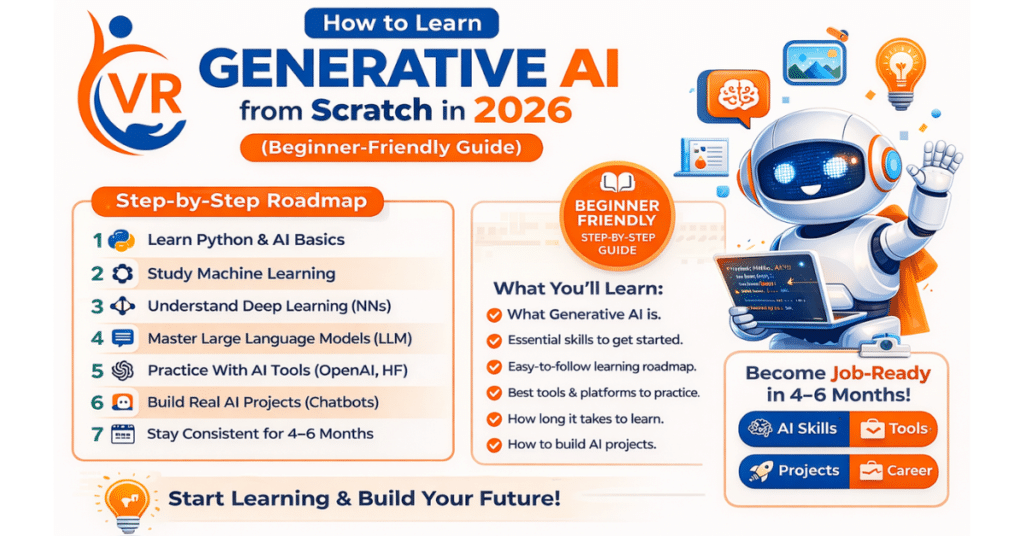
By the end of this article, you will clearly know:
-
What Generative AI is
-
What skills you need
-
A step-by-step learning roadmap
-
The best tools to practice
-
How long it takes
-
How to build projects
-
How to get a job
To learn Generative AI from scratch in 2026, start with Python and basic AI concepts. Then learn machine learning, deep learning, and large language models. Practice using tools like OpenAI, Hugging Face, and LangChain. Build small projects, create a portfolio, and stay consistent. Daily practice for 4–6 months is enough to become job-ready.
If you are a beginner and feel confused about where to start, this guide will help you.
If you prefer classroom or structured learning, you can explore our Generative AI Training in Hyderabad program designed for beginners.
What is Generative AI?
Generative AI is a type of artificial intelligence that creates new content such as text, images, music, videos, or code.
Traditional AI analyzes data and makes predictions.
Generative AI creates new original output.
Examples
-
ChatGPT → Generates text
-
DALL·E → Generates images
-
Sora → Generates videos
-
GitHub Copilot → Generates code
These tools use Large Language Models (LLMs) and deep learning technologies like Transformers.
Why Learn Generative AI in 2026?
Generative AI is one of the fastest-growing technologies in the world.
Companies use it in:
-
Marketing
-
Healthcare
-
Education
-
Software development
-
Finance
-
Content creation
Benefits of Learning Generative AI
-
High-paying jobs
-
Freelancing opportunities
-
Startup potential
-
Automation skills
-
Strong future demand
AI skills are becoming as important as basic computer skills.
Skills You Need Before Starting
You do not need to be an expert. But you should know some basics.
1. Basic Computer Knowledge
-
Using files and folders
-
Installing software
-
Using the internet
2. Basic Python Programming
Python is the most popular language in AI.
You should understand:
-
Variables
-
Loops
-
Functions
-
Lists and dictionaries
3. Basic Mathematics
-
Algebra
-
Probability
-
Basic statistics
Do not worry. You do not need advanced math at the beginning.
Step-by-Step Roadmap to Learn Generative AI
Now let’s break everything into clear steps.
Step 1: Learn Artificial Intelligence Basics
Understand:
-
What is AI?
-
What is Machine Learning?
-
What is Deep Learning?
-
What are Neural Networks?
Simple Difference Table
| Term | Meaning |
|---|---|
| AI | Machines that act intelligently |
| Machine Learning | AI that learns from data |
| Deep Learning | ML using neural networks |
| Generative AI | AI that creates new content |
Spend 2–3 weeks learning these fundamentals.
Step 2: Learn Machine Learning Fundamentals
Focus on:
-
Supervised learning
-
Unsupervised learning
-
Training and testing data
-
Overfitting
-
Model evaluation
Use tools like:
-
Scikit-learn
-
Jupyter Notebook
Practice with small datasets.
Step 3: Learn Deep Learning & Neural Networks
Study:
-
Artificial Neural Networks (ANN)
-
CNN (for images)
-
RNN (for sequences)
-
Transformers (very important)
Transformers power modern models like GPT.
Understand concepts like:
-
Tokens
-
Embeddings
-
Attention mechanism
Spend 4–6 weeks practicing.
Step 4: Understand Large Language Models (LLMs)
Learn how LLMs work:
-
Pre-training
-
Fine-tuning
-
Prompt engineering
-
Reinforcement learning from human feedback (RLHF)
Study popular models and how APIs work.
Step 5: Practice with Real Generative AI Tools
Hands-on practice is very important.
Text AI Tools
-
OpenAI API
-
Hugging Face
-
Google Gemini
Image AI Tools
-
Midjourney
-
Stable Diffusion
Video AI Tools
-
Runway ML
-
Sora
Try building:
-
A simple chatbot
-
A blog generator
-
An AI image tool
See the complete list of Generative AI tools here.
Step 6: Learn Prompt Engineering
Prompt engineering means writing clear instructions for AI.
Bad prompt:
“Write about marketing.”
Better prompt:
“Write a 300-word beginner guide about digital marketing for small businesses using simple language.”
Better prompts produce better results.
Step 7: Build Real Projects
Projects make you job-ready.
Beginner project ideas:
-
AI text summarizer
-
Resume analyzer
-
Customer support chatbot
-
Content generator
-
Image caption generator
Use Python and APIs.
Upload projects to GitHub.
Step 8: Learn Advanced Topics (Optional)
After basics, explore:
-
Fine-tuning models
-
Retrieval-Augmented Generation (RAG)
-
Vector databases
-
LangChain
-
AI agents
These skills increase your job value.
For a structured learning plan, check our detailed Generative AI roadmap.
Generative AI vs Traditional AI
| Feature | Traditional AI | Generative AI |
|---|---|---|
| Purpose | Analyze data | Create content |
| Output | Predictions | New text, image, video |
| Example | Fraud detection | AI content writer |
| Creativity | Low | High |
Generative AI focuses on creativity and content creation.
How Long Does It Take to Learn Generative AI?
It depends on your background.
| Background | Time Needed |
|---|---|
| Complete Beginner | 4–6 months |
| Basic coding knowledge | 3–4 months |
| Software developer | 2–3 months |
If you practice 1–2 hours daily, you can become job-ready in about 5 months.
Consistency matters more than speed.
Beginner Case Study
Rahul was a commerce student. He started learning Python in January.
By March, he learned machine learning basics.
By May, he built a chatbot using an API.
By August, he got an AI internship.
What helped him?
-
Daily practice
-
Building projects
-
Joining AI communities
-
Staying updated
You can follow the same path.
Common Mistakes to Avoid
-
Learning theory without practice
-
Ignoring Python basics
-
Copy-pasting code without understanding
-
Jumping into advanced topics too quickly
-
Not building projects
Avoid these mistakes to grow faster.Pro Tips
-
Focus on fundamentals
-
Practice daily
-
Follow AI newsletters
-
Join Kaggle competitions
-
Connect with AI professionals on LinkedIn
AI changes fast. Keep learning.
Career Opportunities in Generative AI (2026)
Popular roles:
-
AI Engineer
-
Prompt Engineer
-
Machine Learning Engineer
-
AI Product Manager
-
AI Research Assistant
-
AI Content Specialist
Industries hiring:
-
Tech companies
-
Marketing agencies
-
Startups
-
EdTech platforms
-
SaaS businesses
Demand is increasing every year.
If you want hands-on mentoring and live projects, check our Generative AI Training in Hyderabad program.
Learning Resources
Free Resources
-
YouTube tutorials
-
freeCodeCamp
-
Kaggle
Paid Courses
-
Coursera AI specializations
-
Udemy Generative AI courses
Books
-
Deep Learning
-
Hands-On Machine Learning
FAQs
- Can I learn Generative AI without coding?
- You can understand basics without coding. But for a serious career, Python is important.
- 2. Is math very important?
- Basic math is enough in the beginning. Advanced math helps later.
- 3. Is Generative AI hard to learn?
- It feels difficult at first. But step-by-step learning makes it easier.
- 4. Do I need a powerful computer?
- No. Many tools run on the cloud.
- 5. Is Generative AI a good career in 2026?
- Yes. Demand for AI professionals is growing worldwide.
- 6. What is the best programming language for Generative AI?
- Python is the most beginner-friendly and widely used language.
Final Conclusion
Generative AI is a powerful future skill.
If you:
-
Learn Python
-
Understand AI basics
-
Practice regularly
-
Build real projects
-
Stay consistent
You can become job-ready within months.
Start today.
Your future in AI begins now.